
Frankfort Previous-Resident Sources
No single record gives every person who lived at a Frankfort address. Deeds identify parties to land transfers, while a directory or census can identify a household. Maps and permits date the structure or a change to it. Begin with the source closest to the period, then use at least one other record to confirm the person and address.
| Source | Years it covers | Where held | What it shows |
|---|---|---|---|
| Deeds and mortgages | Indexed back to 1795 | Franklin County Clerk and eCCLIX | Grantors, grantees, instruments, and legal descriptions |
| Frankfort city directories | Selected years, 1884-2007 | KHS shelves and microfilm | Names and possible address or household clues |
| Federal census | Public schedules through 1950 | NARA and access partners | Household members and year-specific facts |
| Sanborn maps | 1901 and 1912 sets online | Library of Congress | Building footprint, use, materials, and street context |
| Burial and obituary records | Collection-specific | KHS and Frankfort cemeteries | Deaths, relatives, and trail endpoints |
For recent address history, start with the PVA or tax record and current deed. For older occupants, use the parcel's legal description to bridge backward, then bring in directories, census schedules, maps, and newspapers.
Each source answers a narrow question. The tax roll names the assessed owner. A deed records a transfer or other land interest. A directory can associate a printed name with an address in its publication year. The census describes a household at its enumeration date. None should be stretched into a claim about every occupant between those dates.
Start Frankfort Resident History Today
The Franklin County PVA and county tax systems can return an owner, location address, parcel number, mailing address, values, and other property facts. Copy labels exactly. The mailing address may be a post office box, an estate or care-of line, a business, or another location. It is not proof that the owner lives at the parcel.
Next, open the Franklin County GIS Viewer and match the parcel against the road, city limit, ZIP, subdivision, zoning, floodplain, and address-point layers. GIS boundaries are useful research aids, not a legal survey or ownership certificate. A parcel number and legal description are stronger bridges to old deeds than a street line that may have changed.
Note: Preserve both the situs address and mailing address, but never merge them into one claim about occupancy.
Enter Frankfort Resident Records
The Franklin County Clerk land-record page is the official entry to eCCLIX and the Deed Room. It explains the personal remote account and counter fallback.
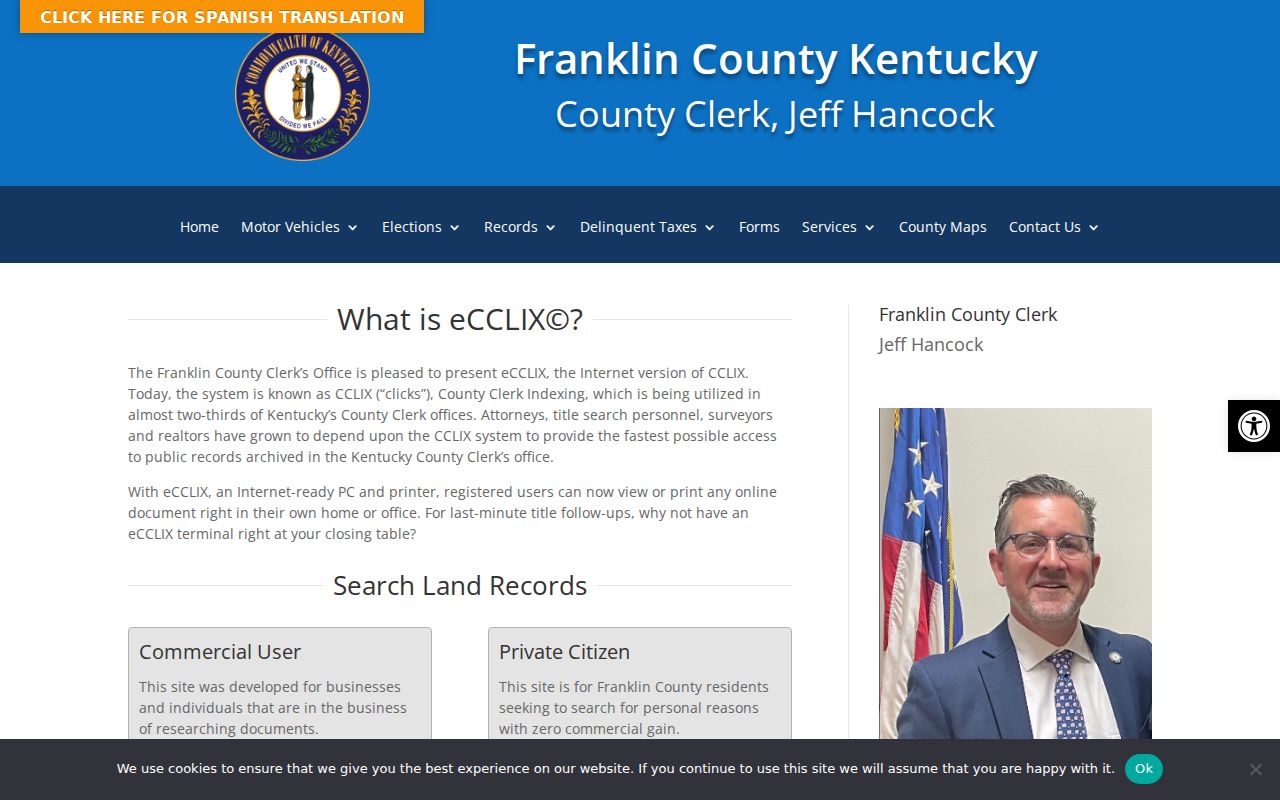
The page points address historians toward the legal index while keeping the clerk's physical records room in view. A private Franklin County eCCLIX account is for personal, noncommercial use and allows five searches per day. Public Deed Room terminals are the practical route when remote access is blocked or the chain reaches older books.
Trace Frankfort Past Residents
Use the current owner's name and approximate purchase period to locate the acquisition deed. Record the instrument type, recording date, book and page, grantor, grantee, and legal description. Then search the seller as a grantee in an earlier deed. Repeat only when the legal description, parcel, lot and block, or subdivision details still match.
- Copy the current owner, parcel number, and legal description from the PVA or tax record.
- Find that owner's purchase instrument in eCCLIX or at the Deed Room terminal.
- Search the grantor, meaning the seller, as a grantee in the older purchase deed.
- Compare the legal description and record each book, page, type, and date.
- Repeat backward, moving to old index books or microfilm when needed.
- Grantor and grantee
- The grantor transfers an interest; the grantee receives it.
- Chain of title
- The linked sequence of recorded transfers for the same legal parcel.
- Legal description
- The lot, block, subdivision, boundary, or other recorded text that identifies land more reliably than an old street number.
The clerk indexes deeds, mortgages, and wills back to 1795. Computer records and liens or encumbrances generally begin in January 1981, while the rolodex index runs through December 31, 2010. Those dates explain why a search may shift from a screen to an older index format. Clerk staff hold the records but do not perform a title search.
If the names connect but the land does not, stop. Estates, trusts, corrective deeds, partial interests, and similarly named people can produce a false chain. Check the legal description, spouse names, recording sequence, and related plat or probate references. When a deed cites an earlier book and page, follow that direct citation before relying on a loose name match.
Frankfort's 1795 Record Reach
The depth of the land index is one of Frankfort's strongest house-history assets. A deed or mortgage trail can reach to the county's early record era, while computer-based lien work has a much later start. That contrast is useful: a blank modern result may mean the search belongs in an old book, not that the transaction never existed.
Plats and subdivision restrictions help when street numbers drift. Plat imaging began in 2004, and the clerk lists full-size copies at $3 in black and white or $5 in color. Older plat access may require a counter request. A plat can connect the modern parcel to a lot and block, but it still does not identify every former occupant.
Mortgages, releases, easements, wills, probate records, liens, and powers of attorney can explain a transfer that is not a simple sale. Capture the exact record type. Never turn an index hit into a claim that an image is online or that an instrument proves occupancy.
Map Frankfort Resident History
The 1901 Frankfort Sanborn set has 19 sheets, while the 1912 set has 35. Sanborn sheets can show a footprint, construction material, number of stories, use, lot setting, and historic street label. They date the built setting, not a resident. Compare the map with a deed and directory entry from the same period.
City and county permit records add later changes. Frankfort Planning and Community Development handles city permits, while county Planning, Zoning, and Building Code Enforcement handles property outside the city's permit jurisdiction. No complete public permit-result index or coverage year was found. Ask by address, project type, and date range at the correct office.
Code files can reveal a notice, lien, demolition, or abandonment date. Those facts describe the property record. They do not establish who slept there or who caused the condition.
The local fallback chain matters because no complete online house-history guide was found for Frankfort. Use the KDLA land-record guide, then contact the Clerk, PVA, city or county planning office, KHS, or Paul Sawyier Public Library with a focused question. A name, parcel, record type, and approximate date will get further than a broad request for everything about a house.
Frankfort Resident Burial Records
The Frankfort Cemetery burial index divides its list into 1844-2005, 2006-16, and 2017-present.
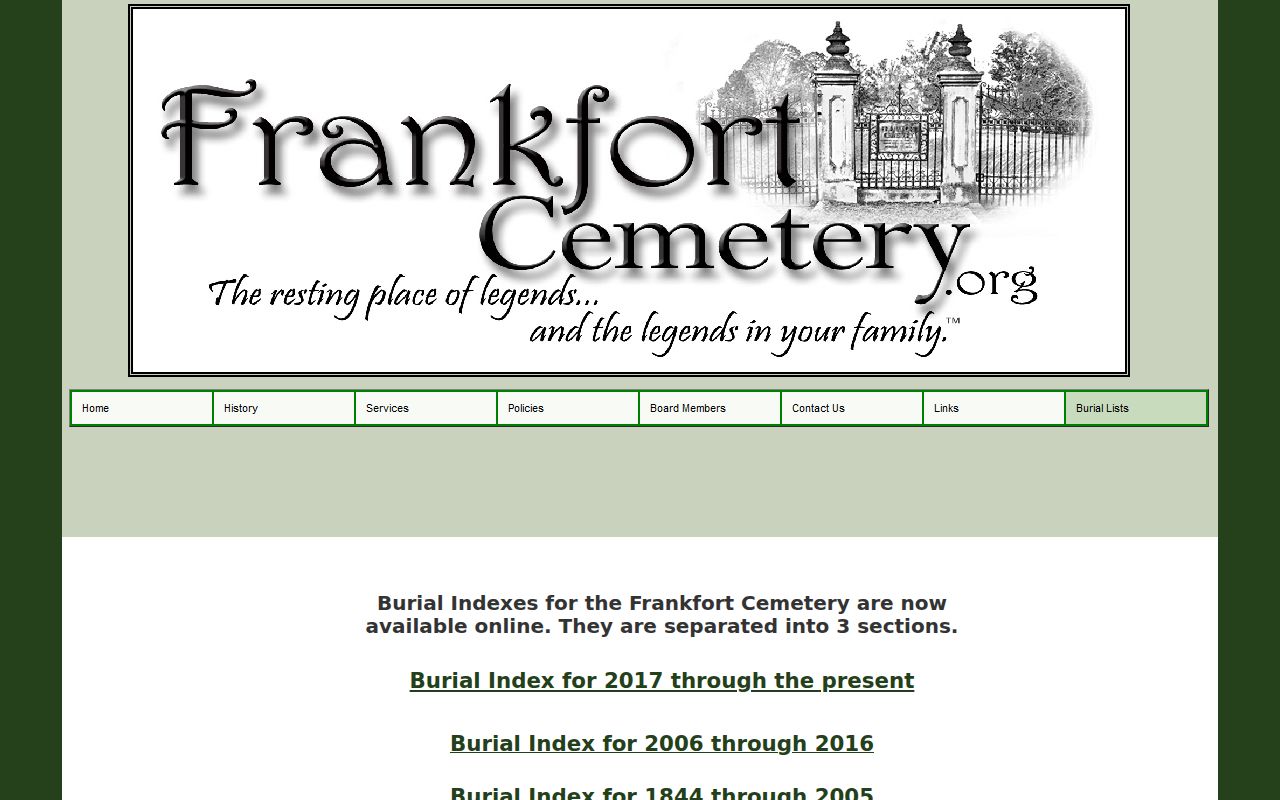
An index match can help explain when a past resident disappears from a directory, but burial place alone does not prove the person's last address. Pair the match with a newspaper obituary, death record, probate file, or the last confirmed city directory line.
Greenhill Cemetery must be searched as a distinct route. Its KHS research collection brings together Black Frankfort community history, obituaries, death certificates, and death-index material from roughly 1911 through 1977. Searching only one cemetery can miss a major part of the city's history.
Frankfort Previous Residents Over Time
Owners are only part of the address story. KHS lists selected Frankfort city directories from 1884 through 2007, including strong runs in the 1910s, 1920s, and later decades. Search a name and address in the newest useful volume, then work backward. The collections and reel details are covered on the Frankfort city directory page.
- Copy the directory entry exactly, including names, street spelling, marks, and year.
- Check the prior listed volume for the same address and each household surname.
- At 1900, 1910, 1920, 1930, 1940, or 1950, compare the public census household.
- Use the 72-year census release rule and remember that most of the 1890 census was destroyed.
- Resolve an endpoint through a newspaper, probate file, obituary, or cemetery record.
A person missing from one volume may have moved, died, changed a surname, been skipped, or fallen into an unlisted year. Do not force the answer. Mark the gap and continue with the nearest dated sources.
Lawful use. Research Frankfort past occupants for house history, genealogy, estate work, or personal curiosity. Never use an address trail to harass, intimidate, or track a living person.